11.30.2010

Fete des Lumieres


French Traditions are numerous and diverse, you already know that.

December 8th is another French Tradition from Lyon, the city where we used to live. Every year since 1852 the people from Lyon celebrate the Festival of Lights which is a popular event that takes place throughout the City on the evening of December 8.


On this occasion and during several days, the City of Lyon is illuminated and festivities are held in different neighborhoods.

This tradition is closely related to the religious history of Lyon.
Since the Middle Ages, the City has venerated the Virgin Mary. It is said that in 1643, the City which had been placed under the protection of the Virgin, was partly spared by a plague epidemic. A statue of the Virgin Mary was erected in recognition, on the Fourviere hill, overlooking the City.


The statue was to be inaugurated on September 8 1852, but the ceremony had to be cancelled due to a severe flood of the Saône river. The inauguration was postponed to December 8, which happens to be the day of the celebration for the Immaculate Conception of the Virgin.

Due to a violent storm, the official ceremony had yet to be cancelled again. However, as the weather rapidly calm down, the Lyon inhabitants, in a spontaneous gesture, placed candles at their windows and descended the streets to lit flares to illuminate the new statue.
The people sang songs and cried "Vive Marie!" until late in the night: The Festival of Lights was born.


This unique Lyonnaise tradition dictates that each year on the evening of December 8, candles have to be placed on the windowsills of every houses, producing a spectacular effect throughout the streets where throngs of people wandering in commemoration until late into the night.

The modern Festival is now a four-day event where contemporary lights installations and fireworks illuminate the City, attracting thousand of visitors.


On December 8, at La Cuisine, we will perpetuate the tradition, by illuminating the inside and outside of the restaurant with a multitude of candles.


You can visit this website for more pictures and infornations about Lyon and its Festival.

11.11.2010

LE BEAUJOLAIS


We might say that November is THE month of french wines at La Cuisine. After the article about Burgundy wines, let's talk about the Beaujolais, because this coming Thursday (Nov 18th) we will celebrate the French tradition:
The Beaujolais Nouveau release!


Since 1951, every third Thursday of November, we celebrate the "Beaujolais Day".

At one past Midnight, from little villages and towns like Romaneche-Thorins, over a million case (around 25 millions liters) of Beaujolais begin their journey through France to Paris for immediate shipment to all parts of the world. Germany and Japan are the biggest market, followed by the USA.


The Beaujolais Region, North from Lyon

Over the years, it has been carried by balloon, motorcycle, truck, helicopter, Concorde jet, elephant, runners and rickshaws.


Apart from the Fanfare, what makes Beaujolais Nouveau so popular? And especially in the U.S. where consumption of red wine is less than 30%?
Simply put that Beaujolais Nouveau is as about as close to white wine as a red wine can get.


Good to know: Gamay (Gamay Noir a Jus Blanc) is the only grape permitted for Beaujolais. All the grapes in Beaujolais region must be picked by hand. These are the only vineyards, along with Champagne, where hand harvesting is mandatory.
Beaujolais is meant to be drunk young, in average vintages it should be consumed by the following May after its release.
However, in excellent vintages (such as 2000) the wine can live much longer and can be enjoyed until the next harvest rolls around.


The "Beaujolais Nouveau" celebration, which began as a local phenomenon in the local bars, cafes and bistros of Beaujolais and Lyon, has become in a few decades one of the most animated rituals in the wine world, encouraging friends to come together and celebrate.
It is a very popular event throughout France as well as in most cities around the world, especially in Japan and the United States.
The race from grape to glass must be silly, but half the fun is knowing that on the same night, in homes, cafes, restaurants, bistros, pubs and bars around the world, the same celebration is taking place.


So, this year, on November 18th 00.01am, we will say
"Le Beaujolais Nouveau est arrivé!", "The New Beaujolais has arrived!".

At La Cuisine, we will be featuring a special 3 courses Menu to celebrate its release.
We can't wait to see wich fruits flavor it will have this year!


10.27.2010

LA BOURGOGNE


As we are entering The Holiday Season, let's talk about French Wines!
You may have already enjoyed some of the wines from our wine list, but have you had a chance yet to try our Burgundy wines?

That's why, Madame, Monsieur, we are going to propose a Wine-Dinner on November 4th @ 7pm, so that you will be ready to make the right choice of wine to pair with your best Holiday meal.


The Burgundy vineyards: 60,000 acres, 99 wine appellations.


No doubt about it, wine is Burgundy 's most famous ambassador. But there is not just one Burgundy wine. Soil and location, altitude and nature has furnished Burgundian wine growers with a whole spectrum of possibilities to create an infinite range of harmonious wines. And nothing goes better with such nectar than Burgundian Cuisine: Charolais Beef, trout, Bresse poultry, Burgundy snails...

Snails in Garlic Butter you may enjoy at La Cuisine

The best known wine terroirs in The Burgundy Region are:

Chablis

Cote de Nuits:
Cote de Nuits - Gevrey Chambertin - Clos Vougeot - Vosne Romanée - Nuit Saint Georges

Cotes de Beaune:
Cote de Beaune - Corton - Pommard - Volnay - Meursault - Chassagne Montrachet

Cote Châlonnaise and Mâcon:
Givry - Pouilly Fuissé - Rully - Macon - Mercurey

All Burgundy Region:
Bourgogne aoc - Bourgogne Alligoté


The main grapes in Burgundy are Pinot Noir for red wine and Chardonnay for white wine. Do you know what is the difference between "Premier Cru" and "Grand Cru"?

Premier Cru: About 600 vineyards in Burgundy merit this appellation. They have been officially designed from the old habits which accepted them as best wines. The name of the village, followed by the name of the vineyard, in the same lettering, appears on the label of a "Premier Cru'.

Grand Cru: Only 33 vineyards have the privilege of being agreed as "Grand Cru". they used to be called "Tête de Cuvée". They are the best among the best: Chambertin, Clos Vougeot, Corton, Montrachet, Musigny....Only the name of the vineyard figures on the label of Bourgogne "Grand Cru".


Good to know: if you are lucky enough to have a Gevrey-Chambertin in your wine cellar, you can expect to keep it for 25 years.


Enough about wines, let's talk about food! Burgundy red wines are excellent with beef, game such as pheasant and boar, roast of pork and delicate cheeses.
White wines go very well with snails, shrimps and goat cheese.

If you plan to visit The Burgundy region, you may enjoy the Bresse chicken (one of the best poultry in the world!), Boeuf Bourguignon, coq au vin (cock in red wine sauce), Dijon Mustard, Sausages (rosette, andouillette, cervelas...).


The Traditional Boeuf Bourguignon

Join us on November 4th and get prepared to the feeling of a trip to France without leaving Ocala! Go on our website to see more details about the menu.

9.03.2010

Do you like Chocolate?

“Life is like chocolate, it’s the bitter that makes one appreciate the sweet” Xavier Brebion

It's not Christmas yet, even not Easter but we don't need any excuses to try, cook and eat chocolate. Dark, sweet, white, stuffed it's always a wonderful experience!
Each French family has its favorite chocolate mousse and cake recipe that is passed down to the next generation. No family gathering is complete without that special chocolate cake that our grandmother used to bake. Maybe that's why the "Chocolate Cake Fondant" at 'La Cuisine' is one of our best desserts.
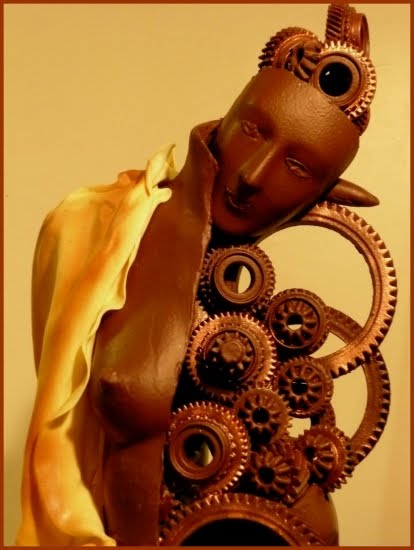
Maitres chocolatiers throughout the country surpass themselves creating unique pieces, patiently and passionately just as an artist would.
In Lyon, we used to live near a "Chocolaterie" (how lucky we were...),
Christophe and Veronique brought their "savoir faire", their joie de vivre and their passion to the city of Craponne, it was always a pleasure to stop by, for our eyes, nose and belly...


So yummy!

Over the past 10 years, the chocolate passion and art seem to appear around the world.
In 2000, the movie "Chocolat", starring Juliette Binoche and Johnny Depp, celebrated the magical attributes of chocolate and even contributed to revitalizing chocolate sales in Europe and North America.


Chocolate is celebrated once a year at the Salon du Chocolat (Chocolate Trade Show). This concept was founded about ten years back in Paris by Sylvie Douce and François Jeantet to create occasions to discover the incredible variety and uses of chocolate. The show is now held around the globe in Paris, New York, and Tokyo but also in Moscow, Dubai and Beijing. Maitres Chocolatiers exhibit and sell their products but there are also classes, dégustation (tasting), presentations and competitions.


A famous proverb says: "nine out of ten people like chocolate, the tenth always lies" John Q. Tulius.
What about you?

4.10.2010

Cheers!


Time is going so fast.....
We hope you had a delightful spring break, or at least, a good Easter! Hope the chocolate was tasty too.

We don't want to talk about chocolate right now (maybe next time, we do love chocolate), but instead, the best alcohol to drink with it: Champagne!


Let us introduce the history of the most popular and loved wine. By the way, did you know that in France, when we celebrate the birth of a newborn, we put a drop of champagne in his lips, don't ask us why, it's a famous tradition, as if to say "welcome to the world baby!". Crazy french people.

This story is quite long but very interesting, actually. We're sure you don't want to miss it:

The tradition of winemaking in Champagne is quite old: it dates back to Roman times.
They are the ones who planted the first vines. In the Middle Ages, the wines from the coast were treated to champagne "Wines of France", which was produced throughout the Paris Basin. The only merit of wines from the region of Reims and Epernay then do not do too much harm to those who drank!. These wines carry the same name today as they did back during the reign of King Henry IV at the end of the sixteenth century: in Paris they were appointed for the first time as "wines of Champagne.


Throughout the seventeenth century, these wines became more and more popular, both at the court of France and the English court, particularly through the support of Parisian family who had large land in Champagne. This family is responsible for the development of "wines of Champagne" gray wine, very slightly colored.

However, the tenants quickly realized that these gray wines weren't aging well in barrels. They decided to bottle them more quickly before the end of the first fermentation in order to retain the best aromas. The first bottling date from the 1660s.

The people of Champagne discovered that the wine was naturally sparkling , faintly colored and low in alcohol content. Additionally, the best time to harvest was the peak of springtime. The English were quickly seduced by this new development: it is perhaps because of them that the bubbly wine remained so popular despite the problems it caused it's growers due to exploding bottles!


The champagne was not yet complete: it was a monk, Dom Perignon, from the Benedictine Abbey of Hautvillers who was responsible for tending the vineyards, wine presses and wine cellars of the Abbey from 1668 to 1715. In 1821another Benedictine monk credited Dom Perignon with inventing the process of creating sparkling wine. Today, we tend to think it was rather the first to perform the assembly. It is certain that this man was a scientist and his winery enjoyed great popularity in his day.

This is the eighteenth century that the champagne started to gain worldwide fame, thanks to famous globetrotters like Claude Moet, Philippe Clicquot, Florenz-Louis Heidsieck. In the nineteenth century, Pierre-Nicolas-Marie Perriet-Jouet, Mumm, Bollinger ... take over. Famous widow as Mrs Pommery, Ms. Clicquot, Perrier Ms to name only resumed the business of their husbands in hand and completed the promotion of champagne quality.

For the record, Champagne Brut was created in 1876 at the request of English, which unlike the French at the time, preferred to drink dry wines.

The champagne was finally recognized as the sacred wine of June 7, 1654 at the accession of King Louis XIV.


Typical house in Reims.


As per the traditions, we use to drink Champagne with... EVERYTHING, and for all events! As appetizers, with friends, during our meal, as you may have tried during our Christmas'Eve, for dessert or for no special occasion, just for the pleasure. We love bubbles...

Many many years ago, from 1900-1914 which is called "La belle Epoque" or 1919-1929 "Les annees Folles", famous artists are sollicited to make advertising for differents brands.


«Biscuits-champagne»
Peinture 1900 d’Alphonse Mucha


1900
Grace Kelly 1980 (if you know our restaurant, you may have seen it)


Scarlett Johansson for MOET, 2009

Ok, she's not Grace Kelly or Scarlett, but nevertheless, Miss Champagne Ardennes 2010

We hope you enjoyed this post and you learned some things, beware, we might ask you some questions about it during your next visit in the restaurant!
Just kidding...